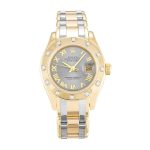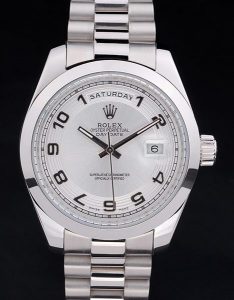
I’m Chris Rovzar, the editor of Bloomberg Pursuits, and I’m here to guide you through the highlights of the 2024 Watches and Wonders fair. As I sit on the flight back from Geneva, I find myself reflecting on an exhilarating week packed with discoveries of new timepieces from renowned brands like fake Rolex, Patek Philippe, TAG Heuer, as well as from emerging names such as Krayon, SpaceOne, and Vanguart.
This edition of the Watch Club newsletter will deviate from its usual format – no CEO interviews or reader wrist checks, just a deep dive into the realm of new watches. So buckle up for a journey through a plethora of horological marvels. (And if you’re perusing this online, make sure to sign up here to stay updated as we return to our regular programming.)
Immersing oneself in a sea of timepieces at an event like this reveals prevailing trends. One standout trend was the prominence of rose gold across various brands. Noteworthy offerings came from Rolex, Vacheron Constantin, Patek Philippe, Baume et Mercier, and Chopard, among others. Interestingly, despite this surge, it seems that consumer demand still favors the allure of yellow gold – bright and lustrous.
The previous year’s fervent pursuit of smaller case sizes appears to have tempered, with a resurgence of larger tool watches taking center stage. Brands renowned for their intricate complications, such as Vacheron Constantin and Jaeger-LeCoultre, unveiled impressive creations, while Piaget and Bulgari showcased their thinnest mechanical wonders yet.
My initial rendezvous at the fair was with Tudor, where I encountered a new monochrome Black Bay alongside a tasteful Coke-bezel Black Bay 58 GMT. Speculation arose regarding a potential return of Rolex’s Coke GMT Master-II, prompted by Tudor’s offerings. However, recent insights from my colleague Andy Hoffman’s compelling coverage of Tudor in Bloomberg Businessweek suggest that Tudor is increasingly distancing itself from its parent brand, making it challenging to extrapolate trends between the two.
Another standout from Tudor was an 18-karat yellow gold Black Bay 58, exuding understated elegance with its olive-green dial. Yet, its subdued demeanor, reminiscent of Tudor’s bronze replica watches, raises questions amidst the prevailing preference for flashy yellow gold.
Patek Philippe’s highlight for the fair was a World Time with an integrated date display, synchronized with the chosen home city at 12 o’clock – an ingenious feature, albeit of limited practicality. Additionally, their Golden Ellipse in rose gold garnered significant attention, particularly for its nostalgic chain bracelet – a delightful nod to the 1970s era of design.
My subsequent meeting with Rolex unveiled their latest offerings, including the subdued black-and-gray bezel GMT-Master II and the ostentatious Deepsea in full yellow gold with a blue dial – a technical marvel capable of withstanding extreme depths, albeit with a hefty price tag and undeniable flamboyance.
Venturing beyond the familiar, I engaged with Elie Bernheim, CEO of Raymond Weil, to explore their approachably priced, well-crafted timepieces. With an annual output of approximately 80,000 fake watches and an average price of $2,000, Raymond Weil specializes in sector dials, offering a gateway into Swiss watchmaking craftsmanship.
Norqain, making its debut at the fair, injected vibrancy into its Wild One Skeleton collection with bold colors in Norteq carbon fiber – a move amplified by celebrity endorsement from Stan Wawrinka.
Ulysse Nardin captivated with the Freak S Nomad, limited to 99 pieces and featuring a mesmerizing diamond guilloché dial – a testament to their innovative spirit.
Bremont, under new leadership, unveiled a revamped brand identity and introduced the Terra Nova collection – a departure from their sea-themed Supermarine line, eliciting mixed reactions from loyalists.
Nomos Glashütte showcased their Tangente with 31 quirky color combinations, celebrating 175 years of watchmaking in Glashütte – a testament to their commitment to innovation and design.
Jaeger-LeCoultre presented the Duometre Heliotourbillon Perpetual, showcasing their patented Duometre system and a mesmerizing three-axis tourbillon alongside a perpetual calendar.
Parmigiani revisited its Toric line, emphasizing exquisite metal and color combinations, while preserving its signature manually wound gold movements.
Watches and Wonders 2024 showcased a diverse array of horological innovations and timeless designs, reaffirming the enduring allure of fine timepieces in an ever-evolving industry landscape.