Rolex unveiled the Land-Dweller – a masterclass in modern watchmaking that marries avant-garde engineering with refined aesthetics. Available in 40mm and 36mm sizes across platinum, white Rolesor, and Everose gold, this integrated bracelet sports watch introduces a sculptural tonneau case paired with a reimagined flat-link Jubilee bracelet. Yet beyond its sleek silhouette lies a horological milestone: the debut of Rolex’s pioneering high-frequency Calibre 7135 movement, anchored by the revolutionary Dynapulse Escapement. Together, these innovations signal a transformative chapter for the brand, blending tradition with radical technical ambition.
The Heart of Innovation: Calibre 7135
At the core of the Land-Dweller beats the Calibre 7135, a movement derived from the Calibre 7140 but reengineered for heightened performance. Operating at 36,000 vibrations per hour – a stark contrast to the industry-standard 28,800vph – the movement achieves exceptional precision by mitigating external disturbances through rapid oscillations. Each vibration acts as a micro-adjustment, averaging out inconsistencies caused by shocks or positional changes. Despite its high frequency, Rolex engineers have coaxed a 66-hour power reserve from the movement, a feat made possible by the Dynapulse Escapement’s groundbreaking efficiency. 
The escapement’s design marks a departure from conventional Swiss lever systems. By integrating two meshing escape wheels – one actively driven, the other passive – the Dynapulse eliminates energy-wasting “dead angles” inherent in earlier designs like Ulysse Nardin’s Dual Direct. Here, each tooth on the escape wheels performs dual locking and impulse functions in a seamless sequence, ensuring continuous energy transfer. The lever remains perpetually engaged, its concave locking surfaces and shark-tooth geometry minimizing friction while eliminating the need for a guard pin. Combined with a silicon finishing wheel in the gear train, the result is a 30% efficiency gain over traditional escapements – surpassing even replica Rolex’s own Chronergy system.
Magnetic Immunity Meets High-Frequency Stability
Complementing the escapement is a fully reimagined balance assembly designed for magnetic resistance and durability. The balance wheel, crafted from a proprietary brass alloy devoid of ferromagnetic elements, pairs with a ceramic balance staff – a first for Rolex – machined via femtosecond laser to eliminate internal stress. This non-magnetic foundation is bolstered by a redesigned Paraflex shock absorber, its double-cone structure and low-stiffness spring ensuring gentle repositioning of the staff during impacts.
The Syloxi hairspring, already renowned for thermal stability, has been recalibrated for high-frequency operation. Thicker, stiffer coils amplify restoring force, critical for maintaining amplitude at 5Hz. Together, these components form an oscillator immune to magnetism and resilient to shocks, yet precise enough to harness the demands of a rapid beat rate.
Design: Heritage Reinterpreted
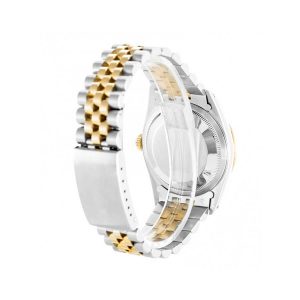
Housed in a tonneau-shaped case echoing the Oysterquartz, the Land-Dweller’s 9.7mm profile belies its technical complexity. Satin-brushed surfaces contrast with polished case middles and bevelled edges, flowing seamlessly into a redesigned Jubilee bracelet. Flat links replace the classic rounded design, their brushed outer and polished center links creating a layered, architectural aesthetic. A concealed Crownclasp ensures uninterrupted lines, while a Twinlock crown secures 100m water resistance.
The dials, adorned with a honeycomb motif, showcase Rolex’s mastery of laser technology. Femtosecond lasers etch brass blanks to depths of 4-25 micrometers, overlaying sunray brushing with textured patterns for multidimensional depth. Chromalight markers, crafted from luminous composite, are machined to razor-sharp precision – their 3D forms glowing with prolonged intensity.
The Land-Dweller is more than a new model; it is a manifesto of Rolex’s evolving philosophy. By marrying a high-frequency movement with magnetic-proof materials and an escapement that redefines efficiency, the brand has crafted a watch that challenges conventions while retaining its signature restraint. For collectors and engineers alike, it represents a watershed moment – a testament to how innovation, when executed with precision, can redefine an industry from within.